



With constant online threats, people expect cybersecurity brands to offer the best protection and most accurate information. Because cybersecurity products and services deal with sensitive data, brands must ensure that both users and search engines see them as credible, authoritative, and trustworthy.
Cybersecurity is considered a Your Money or Your Life (YMYL) category, meaning that Google applies higher standards when ranking content and companies in this space. According to Google, content that demonstrates experience, expertise, authority, and trust (E-E-A-T) for YMYL topics gets prioritized. This guide will explore why cybersecurity brands must integrate E-E-A-T into their SEO strategies and how it can help them stand out.
What Will You Learn:
- How E-E-A-T influences search visibility and trust for cybersecurity brands in a YMYL category.
- What signals Google uses to evaluate experience, expertise, authority, and trust in cybersecurity content.
- How to create and structure content that demonstrates real-world cybersecurity credibility.
- How backlinks, transparency, and site security contribute to long-term SEO performance.
Understanding E-E-A-T in a Cybersecurity SEO Strategy
In Cybersecurity SEO, E-E-A-T helps Google evaluate whether content is accurate, safe, and credible. While it is not a single ranking factor, it plays an important role in how Google assesses content quality. If content clearly demonstrates E-E-A-T, it is much more likely to gain visibility as it reduces the risk of misinformation. Below is how each component of E-E-A-T applies to cybersecurity content and SEO performance.
Experience
Experience in E-E-A-T means that the person who creates the content or the company that provides the service has relevant real-world experience in cybersecurity – whether it’s protecting networks, finding holes, or handling incidents.
Cybersecurity content marketing thrives on credibility and depth, qualities best delivered by individuals with extensive industry experience. Rather than relying on writers with little to no practical background, businesses should seek contributors who have spent years safeguarding networks or developing software to combat malware attacks. These seasoned professionals bring a wealth of firsthand knowledge, enabling them to provide nuanced, detailed insights that resonate with readers. This expertise not only enhances the reliability of the content but also establishes trust.
To leverage experience in cybersecurity content:
- Highlight the professional experience of content creators or staff. Include bios of security analysts, IT professionals, or cybersecurity engineers at the end of each article to build credibility.
- Use case studies from real-world experiences. For example, describing how your security team detected and contained a ransomware incident by focusing on the response steps, technical decisions, and lessons learned.
- Provide step-by-step tutorials and explain how your team’s past experiences in cybersecurity can benefit your audience.
The goal is to build a connection with your audience by showing them that your brand has the experience to understand their problems and offer viable solutions.
Expertise
Expertise means that the person or brand making the content has formal education, certifications, or other well-known credentials in the relevant field. Expertise in cybersecurity usually comes from having industry certifications, experience in the field, and a long list of professional accomplishments.
To demonstrate expertise in cybersecurity:
- Highlight personal certifications like CISSP (Certified Information Systems Security Professional), CISM (Certified Information Security Manager), and CEH (Certified Ethical Hacker), and brand certifications such as SOC2 (System and Organization Controls 2) and ISO certifications
- Provide technical breakdowns of cybersecurity issues, ensuring that your audience knows you understand complex topics.
- Feature guest posts or articles by recognized cybersecurity experts. This could include industry leaders who have experience with emerging threats, malware analysis, or advanced threat protection.
For cybersecurity brands, showing expertise can also mean showing the knowledge that goes into making sure that products and services are safe. Describe how your encryption methods work or how your company stays up to date on the newest cyber threats.
Authority
Simply put, this means how well-known and trusted your brand is in the cybersecurity field. If other reliable sources often mention or link to your brand, this tells Google (and your audience) that you are an expert in the subject. As an authority, your website is the place where people go to get information, advice, and solutions about cybersecurity.
Building authoritativeness requires:
- Establishing your brand as a thought leader. You can do this by regularly publishing content that addresses trending cybersecurity issues, explains new types of attacks, or breaks down the latest regulations.
- Getting cited by other industry leaders. For example, if highly-respected cybersecurity news outlets, bloggers, and podcasters reference your guides, articles, or whitepapers, it strengthens your brand’s authority.
- Presenting research and data-backed insights in your content. Whitepapers usually provide authoritative information backed by real-world data, which strengthens your reputation.
Getting awards in your field or working on big cybersecurity projects with the government or big companies can also make you seem more trustworthy. When it comes to search engines and users, the more well-known your brand is, the more trustworthy you seem.
Trust
Trust is an important component of E-E-A-T, especially for cybersecurity brands. Users will not buy from you no matter how experienced or knowledgeable you are if they do not trust your brand. Being trustworthy means making sure that your website is safe, that your business is open, and that you have a history of keeping your promises.
Here are ways to improve trustworthiness in cybersecurity:
- Display SSL certificates on your website, ensuring that all user data is encrypted and secure.
- Provide clear, easy-to-understand privacy policies and terms of service.
- Include real customer reviews and testimonials. Showcasing positive feedback from satisfied customers builds trust.
- Be transparent about who’s behind the content. Including author bios, contact information, and clear details about your business helps users trust your brand. See an example below.
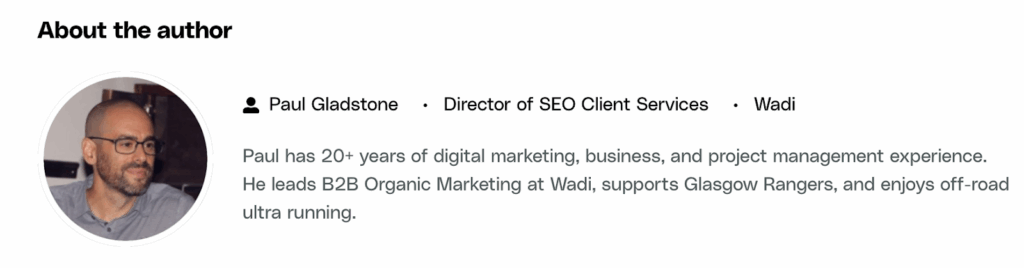
In cybersecurity, trust is paramount because your customers are entrusting you with the safety of their data. Missteps in transparency or perceived dishonesty can significantly damage your credibility.
Interested in a Free E-E-A-T Audit?
Building Trust Through High-Quality Content
Providing high-quality content is one of the best ways to gain readers’ trust and demonstrate authority in your field. This includes blog posts, articles, white papers, case studies, and guides that are useful, informative, and based on good research. Good content not only helps build E-E-A-T, it also makes your brand known as a reliable source of information.
Types of Trust-Enhancing Content
There are several types of content that cybersecurity brands can create to enhance trust:
- Blog posts: Regularly publishing blog posts on relevant cybersecurity topics can keep your audience informed about the latest threats and how to deal with them. Blog posts can also answer common questions or provide tips on cybersecurity best practices.
- Case Studies and Webinars: sharing real-world case studies and webinars that show how security challenges were addressed builds trust and demonstrates your team’s expertise
- FAQ pages: Addressing common concerns, misconceptions, and questions, related to cybersecurity promotes transparency and trust.
The goal is to provide content that not only educates but also shows that you care about your audience’s security and privacy.
Leveraging Case Studies and Whitepapers
When it comes to cybersecurity, case studies and white papers are great ways to show that you are an expert and build trust. Case studies showcase how your brand helped a real client protect their network or get back on their feet after a cyberattack.
Whitepapers, on the other hand, provide an opportunity for an in-depth analysis of certain topics, displaying your technical knowledge and insight. Whitepapers are a great way to educate readers about complicated cybersecurity concepts, as well as make your brand stand out as a thought leader.
Backlink Strategies to Enhance E-E-A-T
One of the most important things for building authority in SEO is backlinks. For cybersecurity brands, getting links from well-known, trustworthy sources in the field tells Google that your website is trustworthy. Getting backlinks from government websites, schools, and well-known cybersecurity blogs is a great way to raise your E-E-A-T score.
Here’s how you can enhance your E-E-A-T through backlinks:
- Earn links from industry-specific blogs and websites: Reach out to cybersecurity influencers or sites that frequently discuss cybersecurity topics.
- Guest post on reputable platforms: Writing guest posts for established cybersecurity blogs can help you build your brand’s authority.
- Get cited in news outlets or industry publications: When other trusted sources cite your brand, it’s a strong signal of your expertise and authority.
- For more information, see Google E-E-A-T: What Is It & How To Demonstrate It For SEO
Remember that not all backlinks are created equal. Focus on earning links from high-authority sites that are relevant to your field.
Monitoring and Improving Your E-E-A-T Score
It takes time and effort to raise your E-E-A-T score. To keep up and get better over time, you have to keep working at it. Use tools like Google Search Console to keep an eye on your website’s performance and see how well your content is doing and if it is meeting users’ needs and expectations.
Auditing your content for E-E-A-T should be a regular process. This includes:
- Checking that your content is up to date and still relevant.
- Ensuring that your content creators’ bios are current and showcase the right expertise.
- Verifying that your website is secure and user-friendly.
Auditing not only helps you stay on top of your E-E-A-T but also ensures that your brand continues to build trust with users and search engines.
Book your free strategy session with Wadi Digital today
E-E-A-T for YMYL Content in Cybersecurity
“Your Money or Your Life” type content is content that can potentially impact a reader, and pertains to finance, health, or well-being. Cybersecurity, which is about keeping personal information safe, is considered a YMYL niche. Google is extra careful when reviewing YMYL content as giving false or misleading information in these areas can have a negative impact on a person’s life.
Cybersecurity brands need to ensure that their YMYL content:
- Is written by individuals with relevant expertise and experience.
- Provides accurate, trustworthy information.
- Is regularly updated to reflect the latest cybersecurity threats and best practices.
Conclusion
Focusing on E-E-A-T is important for cybersecurity brands to build trust, get higher search rankings, and show they can be trusted. Using experience, expertise, authoritativeness, and trustworthiness in your SEO strategy will not only improve the reputation of your brand but also give your audience useful, reliable content.
Key Takeaways
- Cybersecurity SEO operates under stricter scrutiny because it is classified as YMYL content, requiring higher standards of accuracy, credibility, and safety.
- E-E-A-T strongly influences visibility in cybersecurity search results by shaping how Google evaluates content quality and risk, even though it is not a direct ranking factor.
- Demonstrating real-world experience and verified expertise is essential, as content without practical or technical depth struggles to earn trust or compete in SERPs.
- Authoritativeness is built through recognition from credible industry sources, including authoritative backlinks, citations, research, and thought leadership content.
- Trust is reinforced through transparency, secure websites, clear authorship, and consistently updated, high-quality content that prioritizes user safety and reliability.
FAQs
What is E-E-A-T in cybersecurity SEO?
E-E-A-T stands for Experience, Expertise, Authoritativeness, and Trustworthiness. In cybersecurity SEO, it helps Google evaluate whether content is credible, accurate, and written by qualified professionals in a high-risk (YMYL) niche.
Is E-E-A-T a ranking factor?
E-E-A-T itself is not a direct ranking factor, but Google uses related signals—such as author credibility, content quality, and site trust—to inform how pages are evaluated and ranked.
Why is E-E-A-T especially important for cybersecurity brands?
Cybersecurity is considered YMYL content, meaning misinformation can cause real harm. Google applies higher quality standards, making trust, expertise, and authority critical for visibility and rankings.
How can a cybersecurity brand improve its E-E-A-T?
Brands can improve E-E-A-T by publishing expert-written content, showcasing credentials and case studies, earning authoritative backlinks, maintaining a secure website, and keeping content up to date.
Related Articles: